
Taunton City Directory Holdings
The Massachusetts State Library's official holdings list is the starting point for a Taunton historical-directory search. It identifies selected early issues, a long later run, and civic lists that can help place a name in a particular year. The list proves a holding, not a person's appearance in it. Confirm the volume, format, and page before treating a catalog result as evidence. Taunton Public Library and Old Colony History Museum add local channels that supply context the statewide list cannot.
| Collection | Years | Where Held | Access |
|---|---|---|---|
| State Library Taunton directory volumes, early issues | 1855, 1857, 1859, 1861, 1864, 1866, 1869, 1870-71, 1872, 1874, 1876, 1878, 1880, 1881-82, 1884, 1885, 1887 | Massachusetts State Library | Official holdings list; confirm volume access with the library |
| State Library Taunton directory volumes, long run | 1889-1942, catalog-marked 1927-42* | Massachusetts State Library | Catalog holding; the asterisk is a catalog mark not explained on the list |
| State Library later directory snapshots | 1943-44, 1945, 1947, 1954, 1956, 1962, 1964, 1966, 1967, 1969, 1976, 1980 | Massachusetts State Library | Selected issues, not an uninterrupted annual sequence |
| Voting lists and Blue Books | Voting lists: 1924, 1966, 1976, 1978, 1979, 1980, 1988-90, 1992; Blue Books: 1973, 1974, 1981-82, plus Taunton & vicinity 1971-72 and 1972-73 | Massachusetts State Library | Civic-list companion sources with separate inclusion rules |
| Local-history companions | Gazette microfilm 1850-present; yearbooks with noted gaps | Taunton Public Library | Reference help and in-library resources |
The earliest Taunton directory holding identified in the official list is 1855. That is not proof that no earlier directory was ever printed. Gaps matter just as much as available years, especially when tracing a move or a name spelling through several decades.
Taunton Directory Timeline
The collection has useful anchors for a historical timeline, but it is not a single, unbroken publication run. Start with the issue closest to the event date and then work outward. A two-year gap may be ordinary collection coverage, not proof that a household left Taunton.
- 1855: the earliest official State Library holding listed for Taunton.
- 1889-1942: a sustained listed directory run, with a catalog asterisk appearing from 1927 through 1942.
- 1943-1980: later issues survive as discrete snapshots, including 1943-44, 1945, 1947, and selected years through 1980.
- 1924-1992: selected voting lists and Blue Books offer parallel civic-list dates, but they do not replace a directory.
Use the State Library's directory and voting-list holdings as the citation for this shelf. When a scan is used, preserve its own page or image reference too. A catalog list records the collection's existence; it does not settle whether an individual was printed in a specific issue.
Note: Preserve the volume year and catalog wording before comparing a listing with any later historical source.
Taunton Library Directory Desk
Taunton Public Library offers a local place to verify a title, ask about access, and broaden a bare listing into a dated local record. The reference desk is at 12 Pleasant Street in Taunton, MA, reached at 508-821-1410 or tplreference@sailsinc.org. Listed hours are Monday through Thursday, 8 a.m. to 8 p.m.; Friday, 8 a.m. to 5 p.m.; and Saturday, 9 a.m. to 4 p.m. Check current hours before a visit. The library identifies in-library Ancestry access, Taunton High yearbooks except 1910, 1928, and 2014, and Taunton Daily Gazette microfilm from 1850 to the present.
The Taunton Public Library contact information is the source for this local research channel.
Use the contact details to confirm whether a desired historical volume is available in the needed format before traveling or citing it.
The Gazette is especially helpful for a move, death, marriage, public notice, business notice, school event, or civic appearance. Search an address, a spelling variant, and an event date, not a name alone. A yearbook can connect a person to a class or activity, but a gap in the online collection does not prove that the class or person was absent.
Reading Taunton City Directory Entries
An 1889 sample shows why a line should be transcribed rather than summarized from memory. The local format can carry a name, initial, occupation, a business or street address, a house address, boarding status, a cross-reference, or a notation about removal or widowhood. It may distinguish a business location from a home. It can also omit children, spouses, temporary residents, and people outside the directory's coverage. Do not turn one line into a complete household claim.
| Printed name form | Record initials, spelling, punctuation, and any cross-reference exactly as shown. |
|---|---|
| Occupation or trade | May help separate people with the same name, but it is a dated directory description. |
| Address fields | May distinguish a business address, a house address, or a boarding location. |
| Relationship notation | Widow, removal, boarder, or similar wording can be a lead that needs another source. |
| Volume citation | Keep the year, page, and image location with the transcription. |
The printed image is the authority. OCR can confuse initials, punctuation, and street names, so check the image even when a text search appears to fit.
- Criss-cross directory
- An address-ordered section, when present, that lets a reader approach a listing by street rather than surname.
- Householder index
- A name or address finding aid that points toward the main entry; it is not automatically a full household list.
- Abbreviation key
- The volume's explanation of its shortened terms. Photograph or note it before interpreting repeated marks.
- Entry marks
- In the 1889 sample,
h.signals a house or residence;b.is an abbreviated boarding notation;boardsstates the arrangement in full; anddo.means ditto, repeating the preceding term or address.
Trace Taunton Directory Households
A household trail needs a date on every source. Begin with the most likely volume and copy the entry exactly, then compare the nearest listed earlier and later years. Pair the volume with the closest released federal census schedule for the decade. The public schedules run through 1950, so an 1880s directory can be tested against the 1880 or 1900 census, while later listings need other dated local records between censuses. This keeps a directory address, a census household, and a later parcel record from being treated as the same kind of evidence.
- Choose a listed Taunton directory issue closest to the year in question and record its page and printed name form.
- Check the preceding and following available directory issues, including spelling cross-references and changed street wording.
- Pair the period with the closest released census year, then note which names and relationships come from the census rather than the directory.
- For 1902-1963 target years, compare the matching Old Colony History Museum street assessor list by ward and address.
- Use Gazette microfilm, cemetery material, a deed, or an assessor record to test a move, death, property event, or street change.
A disappearance can mean a move, death, changed spelling, omitted listing, or something else. It is not a conclusion by itself. When a historical listing needs a modern address-keyed check, the Taunton streets reference takes up the parcel and street-record angle without replacing the historical collection.
Compare Taunton Street Lists
The Old Colony History Museum adds a useful comparison layer to the city directories. At 66 Church Green, its research resources identify cemetery and grave transcriptions, municipal material, and Taunton Street Assessors Lists for 1902-05, 1912, 1928, 1930, 1934, 1939, 1950, and 1963. The lists organize registered voters by ward, address, occupation, and sex. That makes them valuable for reconciling an address in a selected year, but their voter basis means they are not a complete resident roll.
The Old Colony History Museum research resources describe these local holdings.

A directory listing and a street assessor entry may agree, differ, or describe different roles at one address. Keep each source's own labels rather than forcing them into one household narrative.
Taunton Directory Digital Clues
Digitization is uneven, so a browser result should be treated as one channel rather than the whole archive. Old Colony History Museum's digital collections include the Reed & Barton Virtual Archive, announced on February 11, 2025. Its company records span 1824-2017 and can add documented industrial context when a directory occupation or address points in that direction. It is an institutional and company-history lead, not a name-search substitute.
The Old Colony History Museum digital collections provide the entry point for these projects.
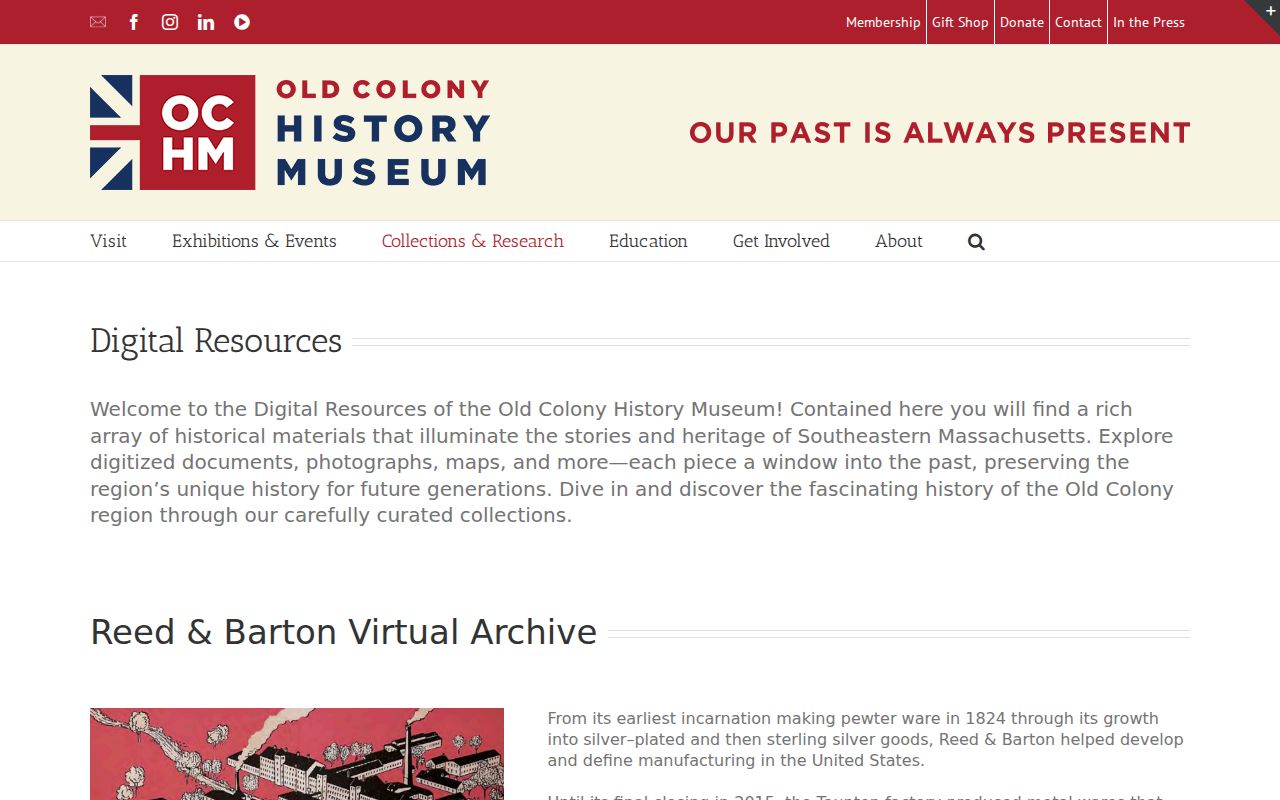
Save the collection metadata and image location with any finding. A digitized record can preserve a page, yet it still needs to be read alongside the volume year and the source's description.
The museum's Proprietor's Records catalog reaches from 1640 into the early 1900s and includes land, town, church, tax, and government materials. It can explain early place or family context, but the catalog description does not prove that a person occupied a later street address.
Taunton Directory OCR Quirk
A false negative often begins with a misread line. The 1889 sample includes spelling cross-references, showing why a name should be tried in more than one printed form. Initials, apostrophes, street punctuation, and abbreviated words are all easy for OCR to flatten or alter. Search broadly, then return to the page image before recording what the printed Taunton volume actually says.
For building context, the 1898 Library of Congress Taunton Sanborn set has 57 sheets. It can show structures, uses, street names, and some house numbers, but it does not name residents. Use it to test whether an address was a dwelling, shop, factory, stable, or another mapped use, not to identify a person at that building.
Note: A clear transcription preserves uncertainty when ink, scan quality, or an abbreviation makes a word hard to read.
Taunton Directory State Resources
The State Library is more than a list of years. Its genealogical resources guide helps researchers use Massachusetts collections with attention to catalog detail, format, and citation. The library holdings should be paired with local reference help when a title, access rule, or scan location is uncertain. That is safer than assuming every listed Taunton volume is freely available online or that every entry has been indexed accurately.
The Massachusetts State Library genealogy guide offers the broader institutional route.
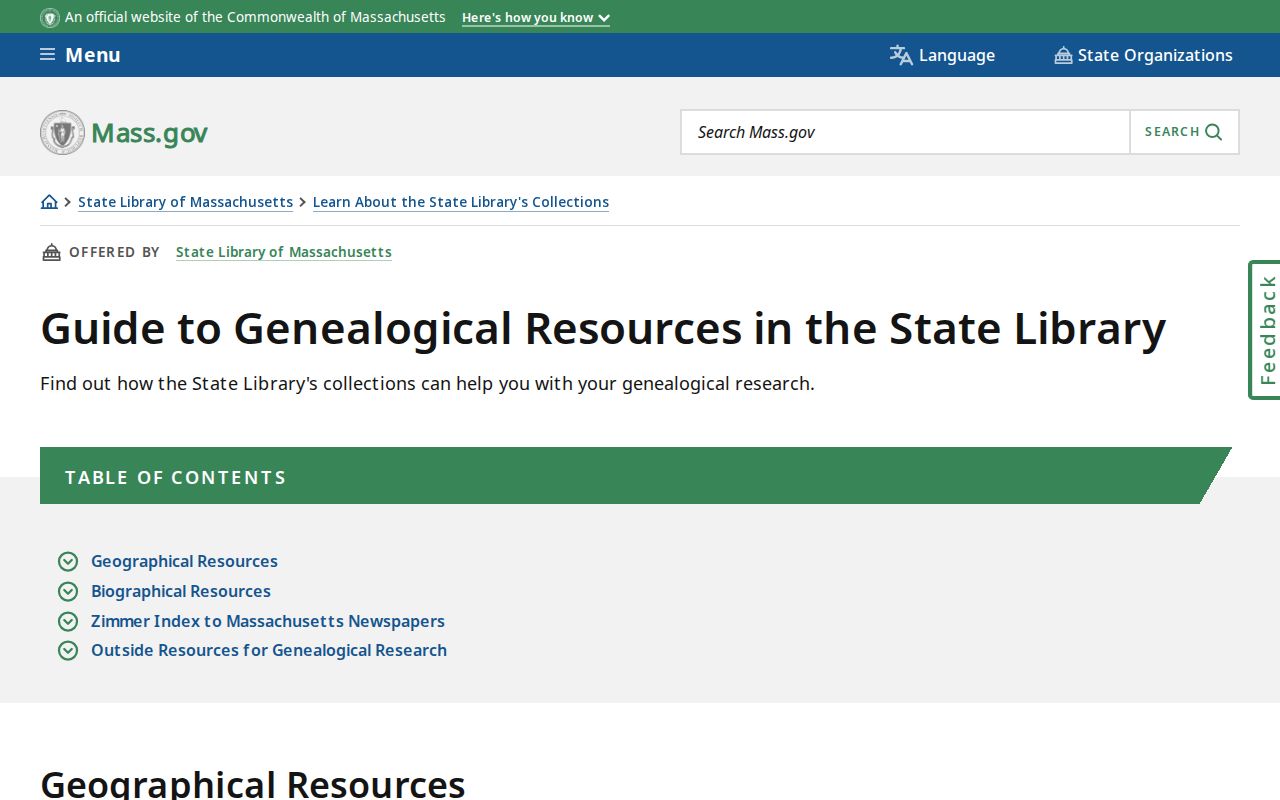
Use the State Library list for the exact Taunton year run, then use a page image or local reference source for the particular statement being cited.
When an old directory result needs a current Bristol County administrative check, the Taunton Assessor / Vision Government Solutions record and the Northern Bristol County Registry of Deeds / Bristol North District describe parcels and recorded instruments, not historical directory membership. Massachusetts Online Voter Registration / Check Registration Information is also a limited self-check, not a historical browsable list.
Taunton Directory Research Limits
Historical directories are useful because they are dated and specific, not because they are complete. A name may reflect a house, a boarding location, a business address, a widow notation, or a cross-reference. A street assessor list records a different historical purpose. A deed names recorded parties, while a parcel map represents tax and GIS information. Read each source for what it establishes and retain the citation that lets someone check it.
Massachusetts public records are governed in part by the Massachusetts Public Records Law, but access still depends on the custodian and any applicable restriction. For family history, a careful record trail protects both accuracy and privacy. Do not use historical material to harass, threaten, impersonate, or expose a protected person.